



Nashville's largest privately developed mixed-income community earns national recognition — and a spot in the running for Community of the Year. We are proud to share that 445 Park Commons has been selected as the grand winner in the Mixed-Income category of the 2026 MFE Awards, presented by Multifamily Executive magazine. The project is also a finalist for MFE's 2026 Community of the Year, which will be announced at an awards ceremony on Wednesday, November 4, during the Multifamily Executive Conference in Newport Beach, California. This year's program drew more than 240 nominations nationwide, with judges selecting 26 winners across 14 categories. Congratulations to Smith Gee Studio, developer MarketStreet Enterprises and the full project team! A Nashville project built for a range of incomes Located at 445 Benton Avenue, adjacent to Geodis Park at Fairgrounds Nashville, the $123 million development was billed at groundbreaking as the largest privately developed mixed-use, mixed-income project in the city. The six-story building delivers 335 residences, including 120 units reserved for households earning 60 percent or less of the area median income and at least 40 additional units for households earning 80 percent or less. Beyond housing, 445 Park Commons brings 11,000 square feet of ground-floor retail, a 7,500-square-foot micro-business incubator for makers and artisans, and a roughly 500-space parking structure to a corner of the Fairgrounds that is rapidly becoming one of Nashville's most active mixed-use districts. The project was made possible through a partnership that included Metro Nashville, the Tennessee Housing Development Agency, the Metropolitan Development and Housing Agency, the Metro Health and Educational Facilities Board, Berkadia Commercial Mortgage, and tax credit equity investor PNC Bank. Hawkins Partners served as landscape architect for 445 Park Commons, shaping the outdoor spaces that connect residents to one another and to the surrounding neighborhood. Recognition in the Mixed-Income category speaks to what happens when public agencies, private developers, and design partners align around a shared goal. Affordability and design quality belong together, and 445 Park Commons demonstrates that at a meaningful scale in our own city. Congratulations to everyone who brought this project to life. We will be watching on November 4 to see whether 445 Park Commons takes home Community of the Year.

Nashville-based landscape architecture firm recognizes growing leadership within its team NASHVILLE, TN — Wednesday, May 27, 2026 — Hawkins Partners, a Nashville-based landscape architecture and planning firm, is pleased to announce the promotions of Nick Hollopeter to Senior Associate and Lindsey Berringer to Associate. "Nick and Lindsey exemplify what Hawkins Partners is built on — people who grow through the work, raise the bar for those around them, and show up fully every day. Nick has developed into a leader who can shape a project and mentor a colleague in the same breath, while Lindsey brings that same energy and commitment to everything she touches, from her work in the hospitality sector to the way she welcomes someone on their very first day. These promotions are well earned, and I couldn't be prouder to work alongside both of them." - Will Marth, Partner at Hawkins Partners Nick Hollopeter, Senior Associate Nick Hollopeter joined Hawkins Partners in 2016 and has grown into one of the most well-rounded and dependable members of the team. Over the years, he has contributed to and led city-shaping projects across a wide range of sectors — from parks and urban office to multi-family, mixed-use, and hospitality — with standout work on Asurion, Amazon HQ, Gibson Residences, Mars Petcare, Frankie Pierce Park, Belle Meade Village, and the Edition Hotel, among others. In his new role as Senior Associate, he brings a sharp eye for detail and a natural ability to lead and mentor those around him. Beyond project work, Nick has made lasting contributions to the firm's IT systems, education initiatives, and onboarding processes. His work reflects Hawkins Partners' commitment to community-centered design and meaningful placemaking. "It’s hard to believe it’s been nine years — time really does fly when you’re doing what you love! I’ve been so fortunate to work on projects that truly transform our communities, and doing it with a team I admire makes it even better. I’m excited to start this new chapter in my career and keep building on the great work we do together." - Nick Hollopeter, Senior Associate, Hawkins Partners Lindsey Berringer, Associate Lindsey Berringer has been a member of Hawkins Partners since 2019, bringing with her experience from several years working with Raymond Jungles in Florida. Her promotion to Associate recognizes nearly seven years of contributions across a portfolio with a strong focus on hospitality and multi-family work, including Chamberlain House, The Starling, Luxury Full-Service Hotels, Front Row in Huntsville, multiple Modera projects across Nashville, and affordable housing work through Park 24 and The Opaline. She brings a collaborative and mentorship-driven approach to her work that aligns with the firm's mission to connect people to place — and has played a key role in shaping how Hawkins Partners hires and welcomes new team members. “I’m thankful to be part of a team that continually encourages growth, creativity, and collaboration. This is a reflection of the support and mentorship I’ve received along the way, and I’m excited to continue building meaningful work with such an incredible group of people at Hawkins Partners.” - Lindsey Berringer, Associate, Hawkins Partners Congratulations to Nick and Lindsey on these well-earned promotions. Their commitment to these new roles helps strengthen Hawkins Partners' capacity to deliver meaningful, design-forward work across the Southeast. About Hawkins Partners: Hawkins Partners is an award-winning landscape architecture and planning firm based in Nashville, Tennessee, with regional presence across the Southeast. Founded in 1986, the firm is known for community-oriented placemaking, green infrastructure, and public-realm design that connect people to place for forty years.
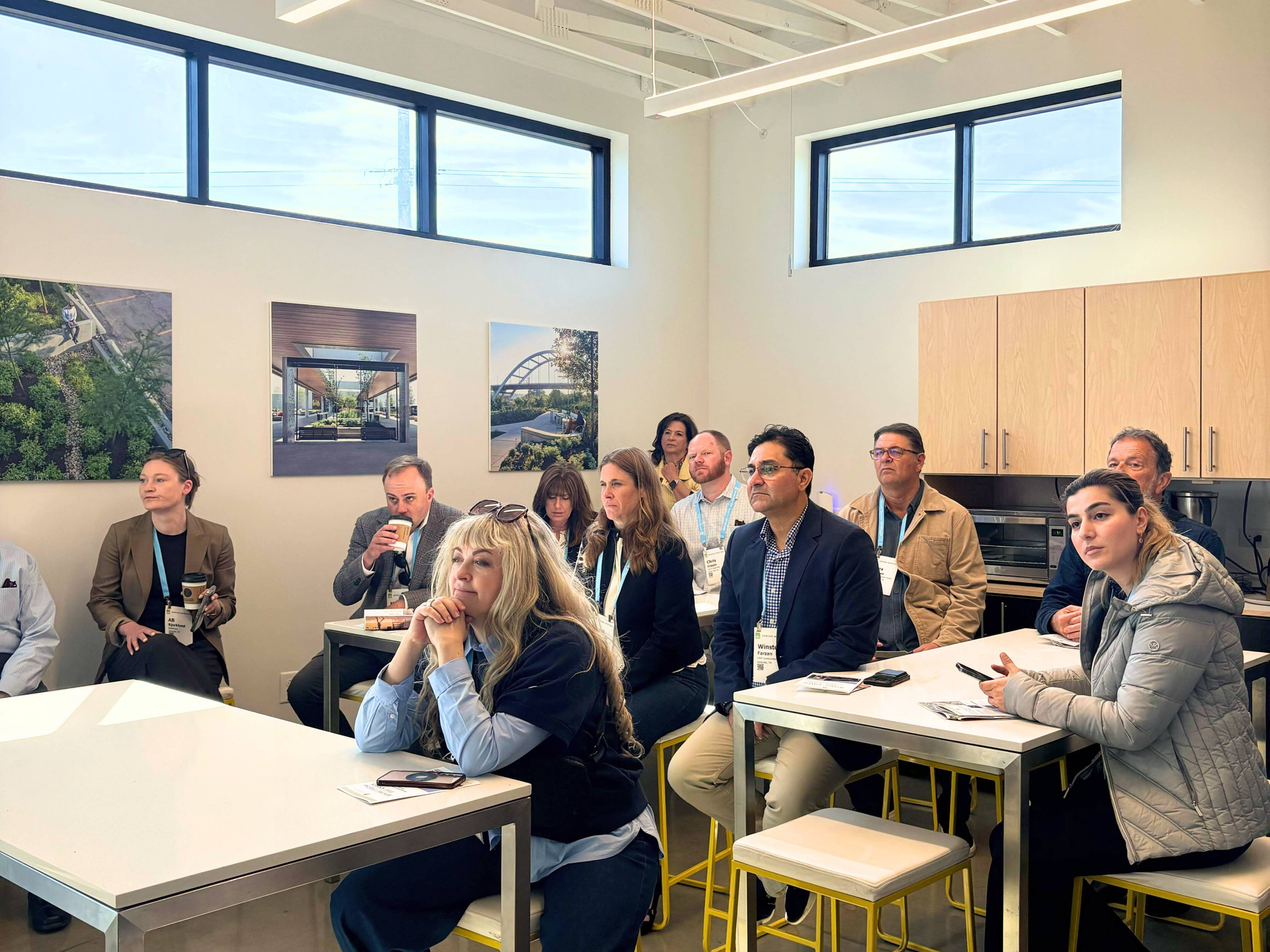
Last week, thousands of real estate, planning, and design professionals from across the country converged on Nashville for the 2026 ULI Spring Meeting and Resilience Summit. For Hawkins Partners, it was a rare opportunity to welcome our industry to our own backyard, and our team showed up in full force to share what makes Nashville such a compelling case study in growth, resilience, and community-centered design. Rolling Out the Welcome Mat The week began before Spring Meeting officially kicked off, when Hawkins Partners hosted the Women's Development Collaborative (WDC) in Nashville for a weekend of touring. Starting from our Five Points office, the group explored East Nashville on Sunday before continuing on to the Wedgewood-Houston neighborhood on Monday, two areas that capture the layered history and rapid transformation happening across the city. From there, the momentum carried straight into Spring Meeting itself. Attendees moved from site visits to sessions to receptions across Nashville throughout the week, and our team was proud to help guide many of those experiences firsthand. Sharing Our Work, In Our City A few highlights from the week: Nathan Oliver and Will Marth helped lead a tour of West Riverfront Park and the Peabody Union/Tolly Barns greenway, two projects that show how public space can reconnect a city to its river. Parker Hawkins hosted a tour titled "Housing the Unhoused: Innovative Solutions to Nashville's Most Underserved Community," spotlighting design approaches to one of the city's most pressing challenges. Brian Phelps joined the panel of the Resilience Summit, "City of Nashville Resilience Panel”. None of this comes together without a lot of coordination and goodwill. Thank you to ULI Nashville and the Urban Land Institute for organizing another outstanding Spring Meeting and Resilience Summit, to the Women's Development Collaborative for a wonderful weekend of touring, and to every attendee who brought curiosity and energy to our tours, sessions, and conversations throughout the week. Nashville continues to grow, adapt, and reimagine itself, and we're grateful for the chance to show the rest of the industry why we love calling it home.
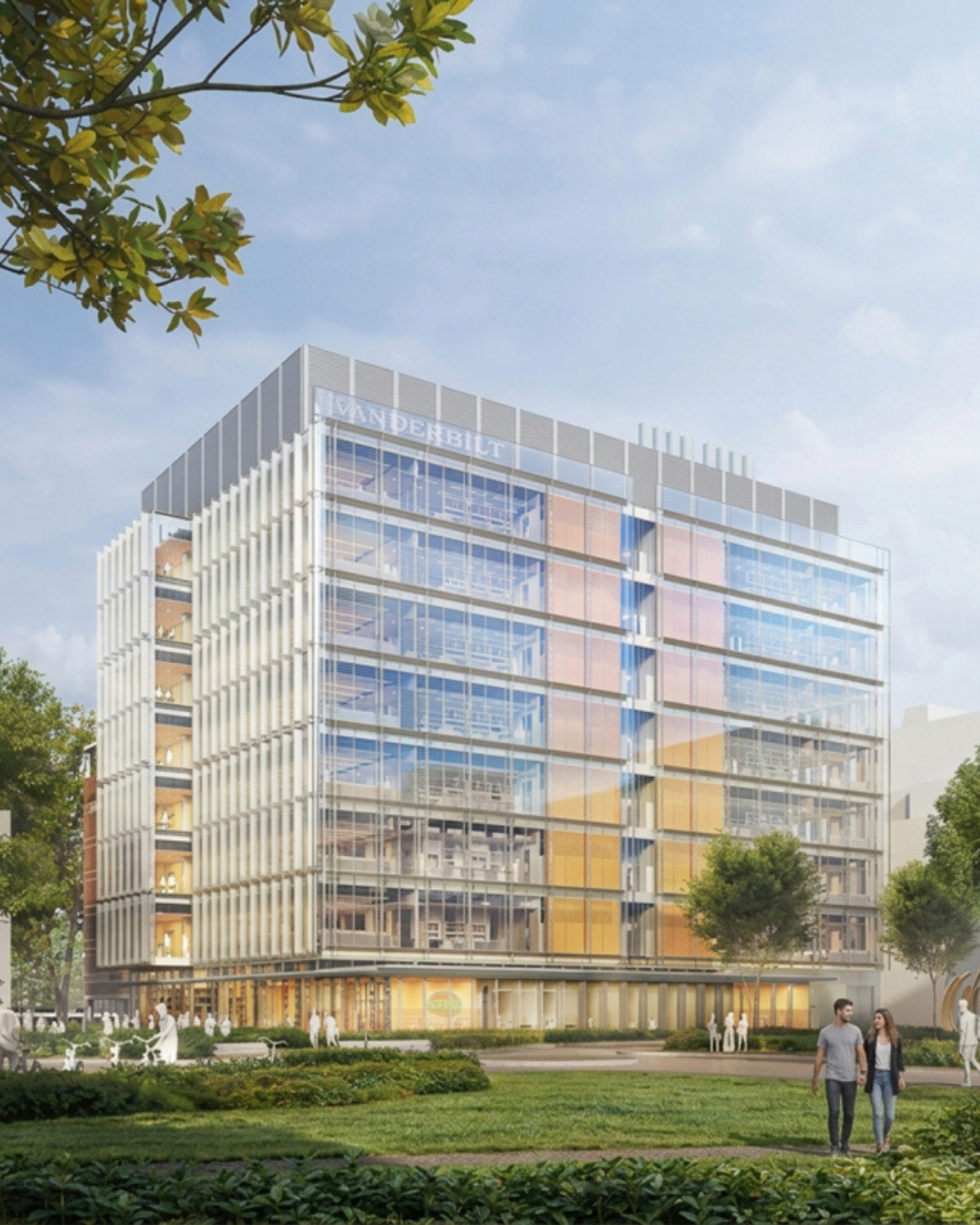
Timeline Groundbreaking is expected this summer, with completion targeted for 2028. Hawkins Partners is honored to help shape a place where scientific discovery and campus community come together. Read the full story from City Now Next: Vanderbilt University Selects DLR Group to Design 10-Story Research Facility in Nashville
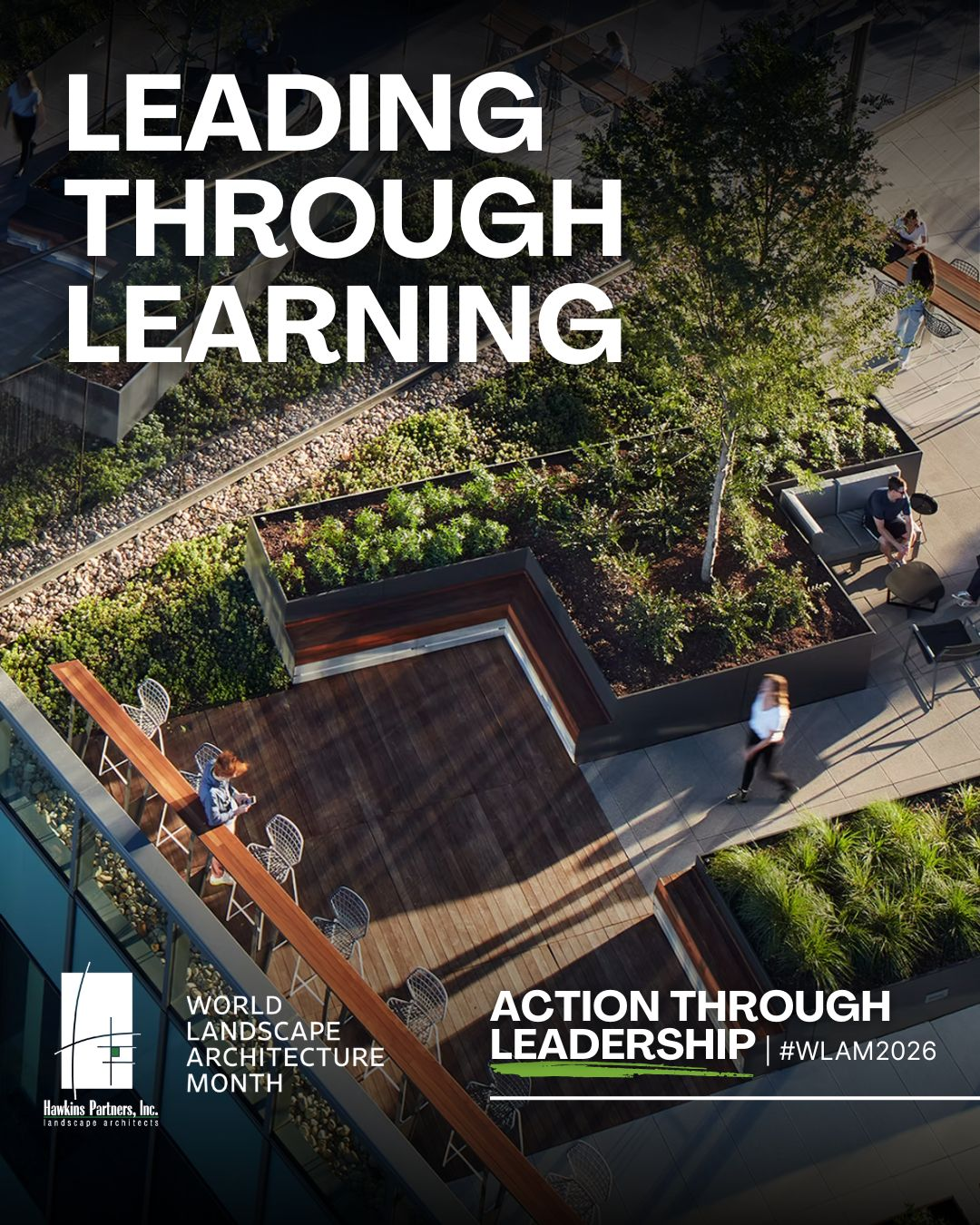
Leading in landscape architecture has never meant having all the answers. It means being willing to ask better questions, and staying curious enough to keep learning as the field evolves. A Field That Used to Work in Silos Twenty years ago, a holistic view of design wasn't the standard. Hydrological systems, ecological health, climate resilience, and social infrastructure were often considered in isolation, if they were considered at all. A stormwater engineer solved for water. A planting designer solved for aesthetics. A social planner solved for community access. These conversations rarely happened in the same room, let alone around the same table. Kim Hawkins, FASLA and founding principal at Hawkins Partners, has watched that shift firsthand over her decades in the field. As she describes it, ongoing learning and implementation keep revealing how these systems overlap, from the smallest ecological details up through the human communities that depend on them. The line between "natural systems" and "human systems" has largely disappeared from how the firm approaches a site. Looking Deeper Into Ecological Systems That shift shows up clearly in the level of detail landscape architects now bring to ecological systems. Kim describes looking beyond plant material and its immediate life cycle, considering instead how it functions within a broader system and contributes to long-term sustainability. It's no longer enough to ask whether a plant will survive in a given site. The better question is how that plant supports the pollinators, soil health, and water cycles around it, years into the future. That longer view means paying close attention to keystone species and assisted migration, planning not just for today's climate but for what a site will need 40 or 80 years from now. It's a level of long-range thinking Kim says wasn't common in the field two decades ago, when most projects were designed around present-day conditions rather than a shifting future. Systems Thinking as a Leadership Skill Today, landscape architects are uniquely positioned to understand how building systems, land, social infrastructure, and environmental health connect, and to bring those elements together in a coherent way. That position comes with responsibility. Few other disciplines sit at the intersection of engineering, ecology, and community life the way landscape architecture does, which means the profession has a growing role to play in how cities plan for a changing climate. Leading in this field means staying curious enough to keep asking what comes next, rather than settling for what has always worked. This wraps our World Landscape Architecture Month series for 2026. Thank you for following along as we explored what makes landscape architecture essential to how we live, work, and connect, through action, practice, learning, impact, and leadership.
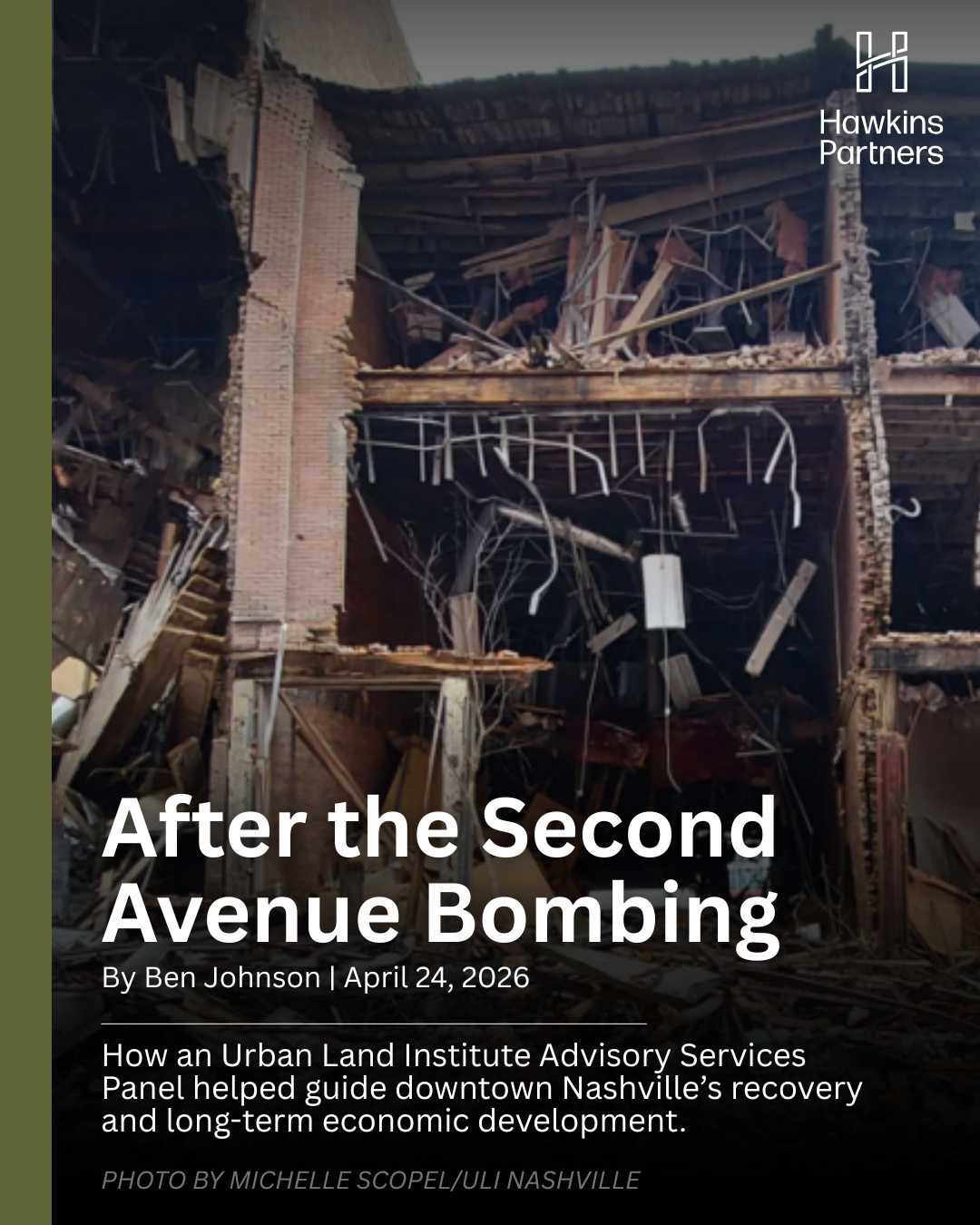
Five years after a bombing damaged more than 65 buildings along Second Avenue North, Urban Land magazine is revisiting the story of the corridor's recovery, and Hawkins Partners founding principal Kim Hawkins is part of the story. At the time of the 2020 bombing, Kim was serving as Chair of ULI Nashville. In the days that followed, then-Mayor John Cooper reached out directly, wanting the Urban Land Institute involved in rebuilding Second Avenue from the start. That outreach led to a virtual Advisory Services Panel, convened within three months of the bombing, where national planning experts worked alongside Nashville leaders to shape a path forward for the corridor. In the feature, Kim reflects on that moment and what it meant for the city and the institute to move forward together. “We were all still very much shell-shocked, and I thought that was incredible recognition and showed how strong our alliance is, between ULI and the city…It let us immediately start thinking about what are the ways that we might be able to jump into this.” Read the full story on Urban Land's website: After the Second Avenue Bombing – Urban Land Magazine
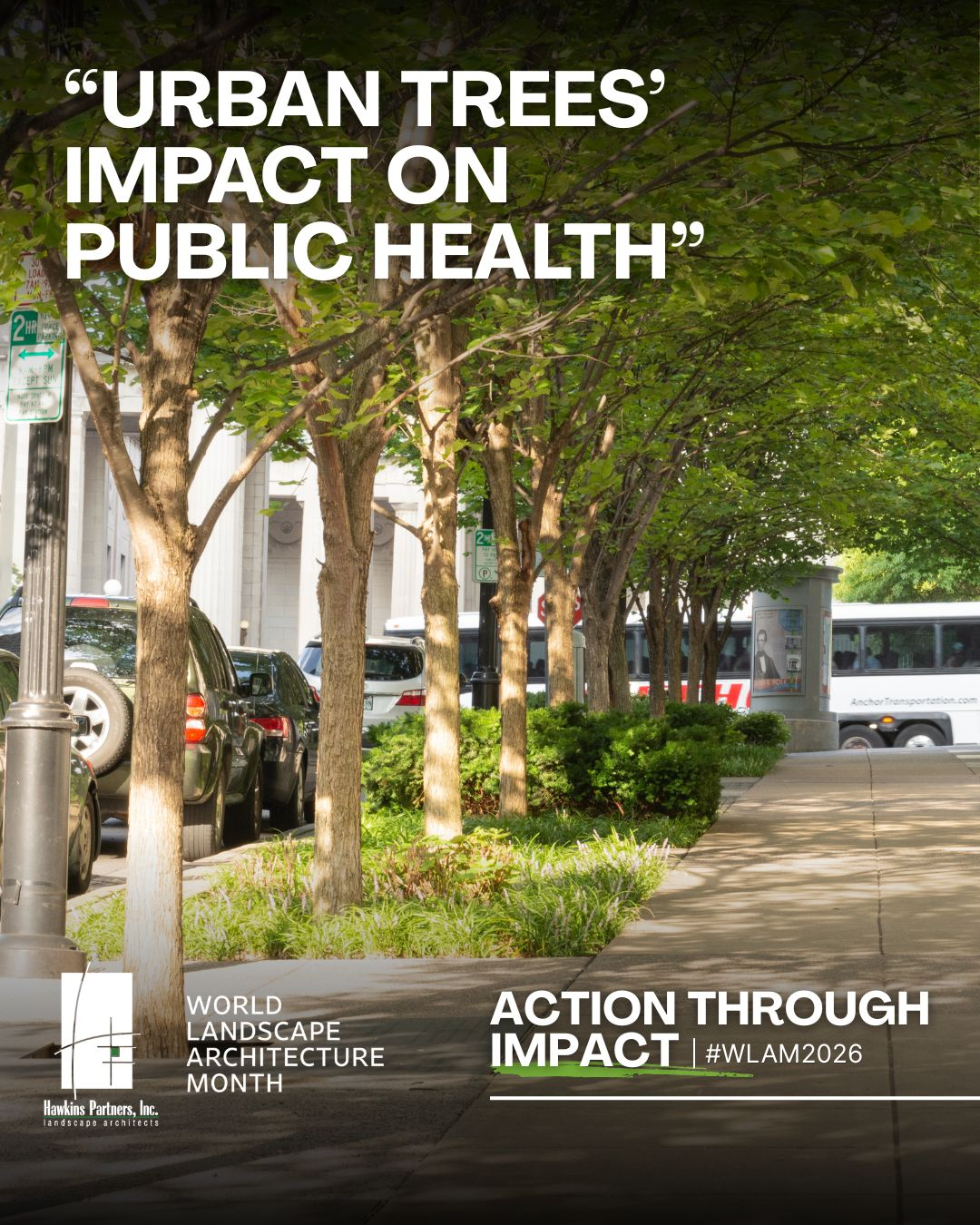
If green space is infrastructure that helps keep people healthy, urban trees deserve to be treated as a determinant of public health in their own right. That's the conclusion of "Urban Trees and Human Health," a study published in the International Journal of Environmental Research and Public Health that analyzed 201 studies spanning epidemiology, medicine, environmental science, and psychology. Reducing Harm The first major impact trees have on our cities is protective. Trees filter air pollutants, buffer UV radiation, and cool the urban heat island effect that makes dense cities measurably hotter than surrounding areas. These protections matter most in the communities least equipped to adapt to their absence: neighborhoods with less tree canopy tend to run hotter, breathe dirtier air, and have fewer resources to offset those conditions through air conditioning or medical care. Tree canopy, in this sense, functions as a form of environmental equity as much as environmental design. Restoring Capacities The second major impact is restorative. Exposure to trees measurably reduces psychological stress and improves mental health outcomes, and in some clinical settings, it even accelerates physical recovery. The research found that neighborhoods with 25% more tree canopy show meaningful drops in depression, anxiety, and stress scores compared to neighborhoods with less canopy. That's a significant shift in mental health outcomes tied to something as simple as the number of trees on a block. Building Capacities The third major impact is developmental. Canopy coverage correlates with better birth outcomes, more physically active communities, and healthier long-term weight status across populations. Trees encourage people to spend more time outside, which in turn supports physical activity, and that relationship compounds over a lifetime into measurable public health outcomes at the population level. What This Means for Design Taken together, this research makes a strong case: urban tree planning should be funded and prioritized as a public health intervention, not treated as an aesthetic afterthought or a line item to cut when budgets tighten. The data connects tree canopy directly to physical health, mental health, and long-term community wellbeing, outcomes that matter as much to a city's health department as to its parks department. Landscape architects play a key role in that shift. Translating research like this into design decisions, and design decisions into policy, means advocating for canopy coverage in every project, from small streetscapes to large public parks, and making the public health case as clearly as the aesthetic one. That's landscape architecture in action through impact.
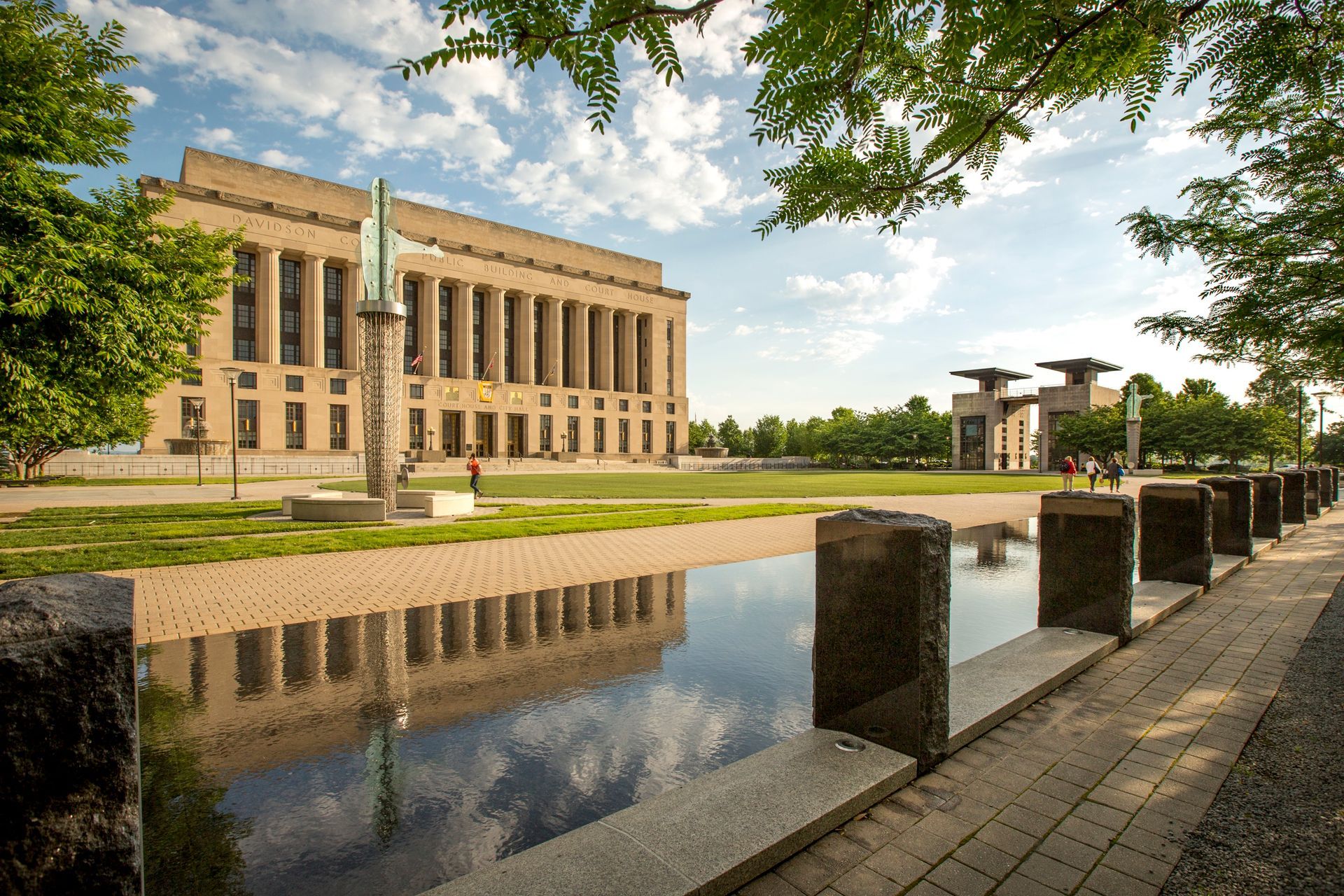
Public Square, the civic green space Hawkins Partners designed above Nashville's Metro Courthouse, is now part of Nashville Sites' growing catalog of curated local history tours. The new "City Hall & Public Square" experience launches today, April 19, and explores the civic and democratic history of one of downtown Nashville's most significant gathering spaces. Designing a Park With History Built In Completed in 2008 as part of a major Metro Courthouse renovation, Public Square sits atop an approximately 6-acre rooftop park designed to support both a parking structure below and a working civic space above. Hawkins Partners designed the park to interpret the site's layered history through landscape, weaving a civic lawn, a WWII commemorative grove, a vendor plaza, and a series of water features into a single connected public space. Sustainability was built into the project from the start. A 57,000-gallon rain-harvesting system captures water for the park's native plant irrigation, reducing the site's demand on the city's water supply while supporting the plantings that give the park its year-round character. The project went on to receive an Award of Excellence from the ASLA Tennessee Chapter, recognition of both its design and its environmental performance. A Living Civic Space Nearly two decades later, Public Square continues to do exactly what it was designed to do: serve as a gathering place for civic events, community celebrations, and everyday downtown life. That ongoing use is part of what makes it a fitting subject for Nashville Sites, whose tours connect visitors and locals alike to the stories behind the city's most meaningful places. Celebrate the Launch Nashville Sites' "City Hall & City Square" tour is free and available now on the Nashville Sites website. The public is invited to celebrate the tour's launch today, April 19, at 3:00 p.m. on the steps of the Historic Courthouse and City Hall. Hawkins Partners is proud to see Public Square's story reach a new audience, and even prouder that, nearly twenty years on, the space still brings people together the way it was designed to.
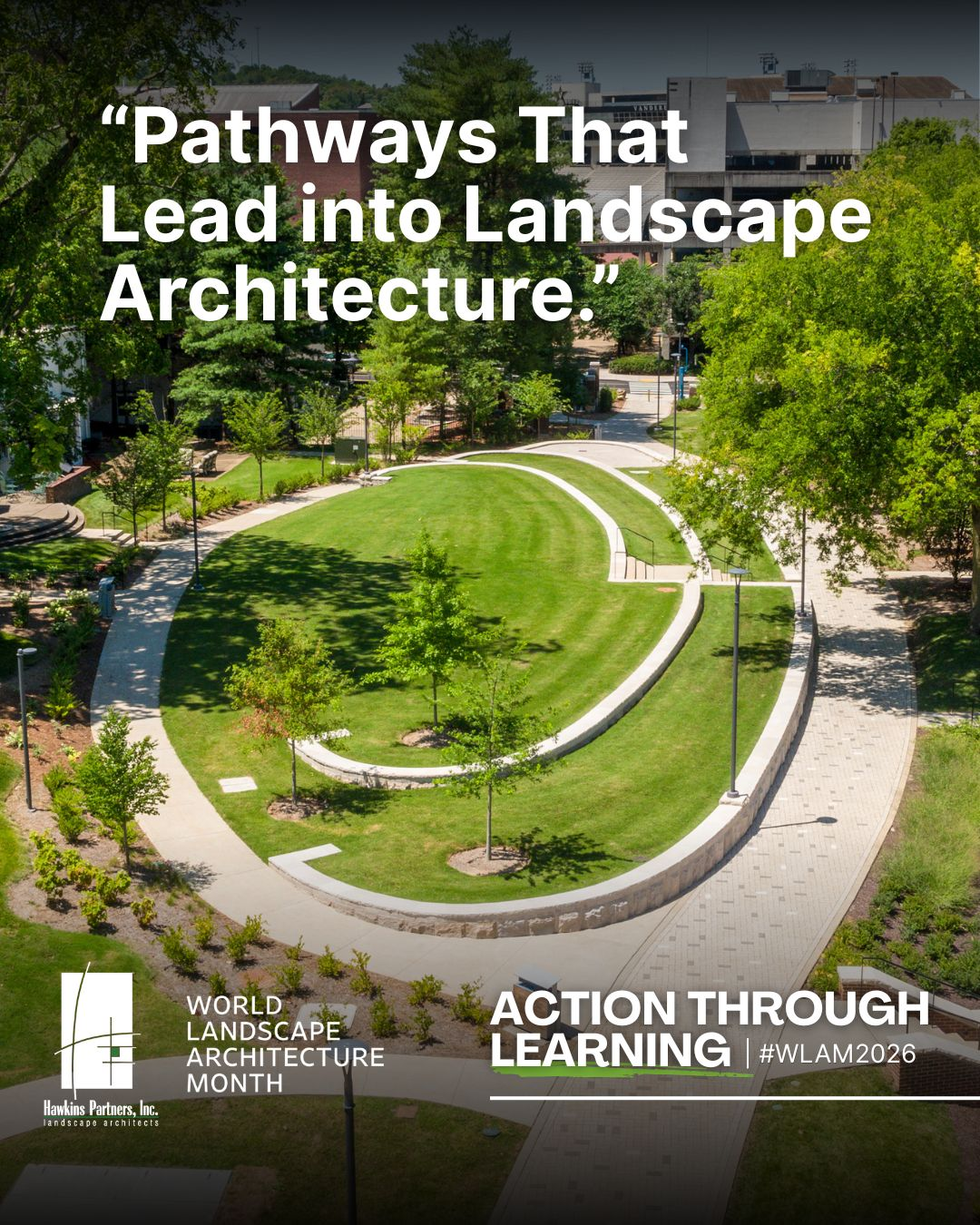
There's no single pathway into landscape architecture. For World Landscape Architecture Month, we asked a few members of #TeamHawkins how they found their way into the field, and their answers reflect just how many directions can lead to the same profession.
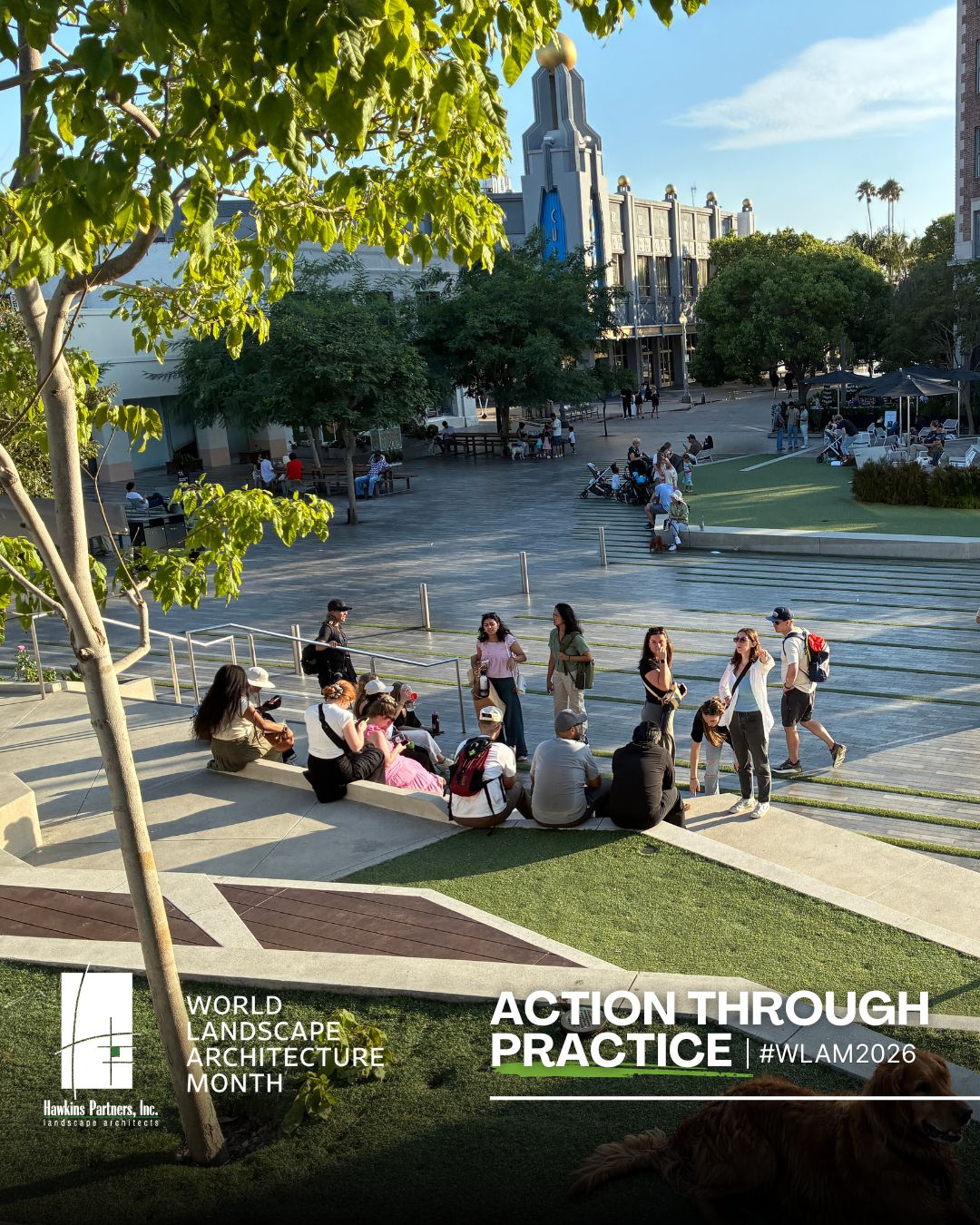
Once a year, the entire Hawkins Partners team gets on a plane together. The destination changes year to year, but the purpose behind the trip doesn't: curiosity, not conferences. Learning by Walking There's no substitute for experiencing a place on foot. The team walks unfamiliar buildings and open spaces, paying attention to details that don't come through in a photograph or a case study: how a plaza catches afternoon light, how a street handles foot traffic during rush hour, how a small park manages to feel busy and peaceful at the same time. These observations focus on how other communities solve problems, allocate resources, and shape the way people gather and move through public life. Every city offers a different answer to those questions, shaped by its own climate, culture, and history. Seeing those answers firsthand, rather than reading about them, changes how the team thinks about design back home. Bringing Ideas Home None of this stays abstract once the trip ends. Ideas that surface during these trips come home with the team and shape the way Hawkins Partners approaches projects in Nashville and beyond. A clever grading solution spotted on a walk through one city might resurface months later in a stormwater strategy for a Nashville park. A planting palette admired in another region might inform how the team approaches resilience and native species selection at home. This annual trip is one of the ways Hawkins Partners stays sharp as landscape architects, designers, and managers. Design skills don't stay sharp through repetition alone. They stay sharp through exposure to new problems and new solutions, and travel is one of the most direct ways to get that exposure. Growing Together as Designer-Citizens The trip is also about the team itself. Traveling together gives colleagues the chance to see a city, and each other, outside the usual rhythm of the office. Conversations that might not happen at a desk happen naturally on a long walk through an unfamiliar neighborhood. This is one of the ways the team grows together as designer-citizens, learning as much from each other on these trips as from the cities themselves. Junior designers see how senior team members read a space. Senior team members get reminded, through a colleague's fresh eyes, of details they might otherwise walk past. Design isn't only shaped by what happens at a desk or in a client meeting. It's shaped by curiosity, by travel, and by the willingness to keep learning from the world around us. That's landscape architecture in action through practice.